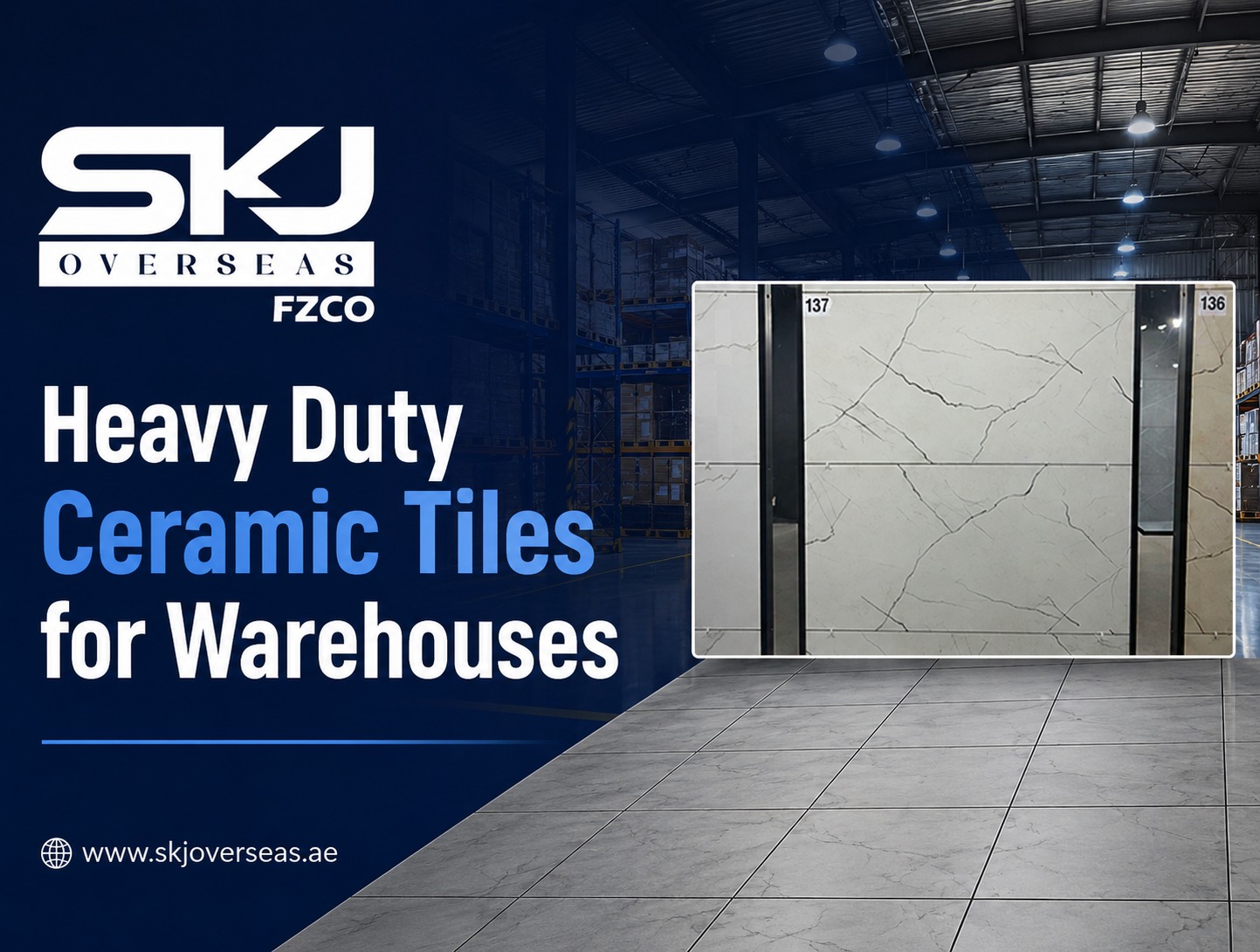
Warehouse floors take punishment every single day. Forklifts, heavy pallet loads, foot traffic, spills, and constant movement all wear down a floor faster than most people expect. Choosing the right ceramic tiles in Dubai for your warehouse is not just about appearance. It is about safety, durability, and long-term cost savings. This guide covers everything you need to know about selecting heavy duty ceramic tiles for warehouse environments, from key performance properties to what separates a reliable ceramic tiles manufacturer in Dubai from the rest.
Warehouse flooring failures are expensive. Cracked or damaged floors create safety hazards, slow down operations, and require costly repairs. Industrial ceramic flooring designed specifically for heavy-load environments solves these problems before they start. The right tiles handle the load, resist chemical spills, stay safe underfoot, and last for decades with minimal maintenance.
Why Standard Tiles Are Not Suitable for Warehouse Floors
Many building owners make the mistake of using standard commercial or residential tiles in warehouses to save money upfront. This almost always leads to higher costs later.
Standard tiles are not designed for:
- Repeated heavy point loads from forklift wheels and pallet jacks
- Impact from dropped goods or equipment
- Chemical exposure from lubricants, cleaning agents, and industrial fluids
- High-frequency foot and vehicle traffic across the same zones daily
- Temperature variation in loading bays and storage areas near external walls
Heavy duty ceramic tiles for warehouse flooring are engineered differently. They have higher compressive strength, lower water absorption, better surface hardness, and anti-slip properties that standard tiles simply do not provide. Cutting corners on warehouse flooring costs far more in repairs, replacements, and liability than investing in the right product from the start.
What Makes Ceramic Tiles the Right Choice for Industrial Warehouses
Industrial ceramic flooring has several properties that make it the preferred choice for warehouse environments:
Compressive Strength Heavy duty warehouse ceramic floor tiles are manufactured to withstand loads from forklifts and racking systems without cracking or deforming. A quality floor tiles manufacturer will provide load-bearing data so you can confirm the tile suits your specific equipment.
Wear Resistance Warehouse floors are constantly abraded by vehicle tyres, pallets, and foot traffic. Wear-resistant floor tiles maintain their surface integrity over years of heavy use, keeping the floor level, smooth, and safe.
Chemical Resistance Spills happen in every warehouse. Oil, fuel, cleaning chemicals, and other fluids can penetrate and degrade standard flooring quickly. High-strength ceramic tiles have very low porosity, which means liquids stay on the surface rather than soaking in. Cleanup is faster and damage does not occur.
Anti-Slip Surface A slippery warehouse floor is a serious safety risk. Properly specified heavy duty anti-slip ceramic tiles for warehouse environments maintain grip even when wet, reducing the risk of accidents involving workers or equipment.
Easy Maintenance Unlike coated concrete or epoxy floors, industrial ceramic flooring does not peel, chip, or require recoating. Cleaning is straightforward and the floor maintains its appearance and performance for many years.
Key Specifications to Check When Buying Heavy Duty Warehouse Tiles
Before approaching any ceramic tiles supplier in Dubai, know the specifications that matter for warehouse use:
PEI Rating (Hardness) The Porcelain Enamel Institute rating measures surface hardness and abrasion resistance. For warehouse floors, look for PEI Class 4 or Class 5, which is rated for heavy commercial and industrial use.
Breaking Strength This measures how much load a tile can bear before cracking. Warehouse tiles should have a minimum breaking strength of 1300 Newtons for standard use areas and higher for heavy forklift routes.
Water Absorption Low water absorption means the tile resists staining and chemical penetration. For industrial applications, look for water absorption below 0.5%, which is the standard for porcelain and high-quality vitrified tiles.
Slip Resistance (R Rating) The R rating classifies slip resistance. For warehouse floors, R10 is a minimum. High-risk wet areas or loading bays should use R11 or R12 rated tiles.
Tile Thickness Warehouse tiles should be at least 10mm thick. For forklift traffic zones, 12mm or thicker is recommended. A good tiles manufacturer will confirm the right thickness for your specific load requirements.
Coefficient of Thermal Expansion Warehouses with large temperature variations, especially near loading bays, need tiles with appropriate thermal stability to prevent cracking from expansion and contraction.
Heavy Duty Ceramic Tiles Comparison
| Property | Standard Commercial Tile | Heavy Duty Ceramic Tile | Industrial Porcelain Tile | Anti-Slip Warehouse Tile |
| PEI Rating | Class 2 to 3 | Class 4 | Class 5 | Class 4 to 5 |
| Breaking Strength | 600 to 900 N | 1300 to 2000 N | 1800 to 3000 N | 1300 to 2000 N |
| Water Absorption | 3 to 6% | Below 1% | Below 0.5% | Below 1% |
| Slip Resistance | R9 | R10 | R10 to R11 | R11 to R12 |
| Chemical Resistance | Moderate | Good | Excellent | Good |
| Suitable for Forklifts | No | Yes | Yes | Yes |
| Thickness | 6 to 8mm | 10 to 12mm | 10 to 15mm | 10 to 12mm |
| Maintenance Requirement | Moderate | Low | Very Low | Low |
This table helps you understand exactly why durable ceramic floor tiles for heavy traffic warehouse areas need to meet a different standard than tiles used in offices or retail spaces.
Where Heavy Duty Ceramic Tiles Are Used in Warehouse Environments
Ceramic tiles for industrial facilities are used across multiple zones within a warehouse:
- Main storage floor where racking systems are installed and forklifts operate daily
- Loading and unloading bays where heavy goods arrive and are moved frequently
- Cold storage areas where temperature variation and moisture are constant challenges
- Workshop and maintenance areas within the warehouse complex
- Corridor and walkway zones separating pedestrian and vehicle traffic
- Chemical storage rooms where spill resistance is the top priority
- Dispatch and packing areas with high foot traffic and occasional light vehicle use
Each zone may require slightly different tile specifications. A skilled ceramic tiles manufacturer in Dubai will help you map the right product to each zone rather than applying a single specification across the whole floor.
How to Choose the Right Ceramic Tiles Manufacturer in Dubai
Finding the right floor tiles manufacturer for your warehouse project means looking beyond price. Here is what to evaluate:
Product Range A capable tiles manufacturer offers multiple grades, thicknesses, surface finishes, and sizes. This flexibility means you can match the right tile to each zone of your warehouse without compromising.
Technical Data Availability Ask for full technical data sheets covering PEI rating, breaking strength, water absorption, slip resistance rating, and chemical resistance. Any reputable ceramic tiles manufacturer in Dubai provides this without hesitation.
Custom Options Large warehouse projects often need custom sizes, colours, or surface textures. Custom ceramic tile manufacturers who can produce to specification save time and reduce waste on large-scale installations.
Quality Certifications Look for ISO certification and compliance with international standards for ceramic flooring. This confirms the manufacturer has quality controls in place at every production stage.
Supply Reliability A large warehouse floor requires consistent supply across the whole project. Tile batches that vary in shade, size, or thickness create visible inconsistencies and installation problems. Choose a ceramic tiles supplier in Dubai with proven batch consistency.
Installation Support A good manufacturer provides installation guidelines, recommended adhesive specifications, joint sizing advice, and surface preparation requirements. This support reduces installation errors and ensures the floor performs as specified.
Common Mistakes When Installing Heavy Duty Ceramic Tiles in Warehouses
Even with the right tiles, poor installation or planning causes early failures. Avoid these errors:
- Using standard tile adhesive instead of heavy-duty, flexible adhesive designed for industrial floors
- Skipping expansion joints in large floor areas, which causes tiles to crack when the floor expands and contracts
- Incorrect subfloor preparation where the concrete base is not level, clean, or strong enough to support the tile and load
- Wrong grout selection using standard grout that absorbs chemicals and stains in a warehouse environment
- Ignoring zone-specific requirements by using the same tile across forklift routes and standard walkways where different ratings are needed
- Insufficient curing time before bringing heavy equipment onto the newly tiled floor
Working with an experienced ceramic tiles supplier in Dubai who provides technical guidance alongside the product helps you avoid all of these problems.
Why SJK Overseas Is a Trusted Ceramic Tiles Manufacturer in Dubai
SJK Overseas supplies heavy duty ceramic tiles and industrial ceramic flooring solutions to warehouses, manufacturing facilities, and commercial projects across Dubai, the UAE, and international markets.
Here is what sets SJK Overseas apart:
- Full range of heavy load flooring solutions in multiple grades, sizes, and surface finishes
- Complete technical documentation including PEI ratings, breaking strength data, and slip resistance certificates
- Custom ceramic tile manufacturing available for non-standard sizes and project-specific requirements
- ISO-certified quality management with consistent batch production
- Established supply track record for large warehouse and industrial flooring projects in Dubai and the Gulf region
- Technical team available for specification advice, zone mapping, and installation guidance
- Competitive pricing with no compromise on product quality or documentation
As a trusted ceramic tiles manufacturer in Dubai, SJK Overseas works directly with project managers, contractors, and facility owners to deliver the right flooring solution for every warehouse application.
Case Study: Heavy Duty Warehouse Flooring Project in Dubai Industrial Zone
Project: A large logistics and storage facility in a Dubai industrial zone
Challenge: The facility was operating on a painted concrete floor that was deteriorating rapidly under daily forklift traffic and chemical spills from cleaning operations. The floor had become uneven in several zones, creating a safety risk and an ongoing maintenance expense. The facility manager needed a permanent flooring solution that could handle 5-tonne forklifts, chemical exposure, and 24-hour operations without requiring regular repair work.
Solution: SJK Overseas was contacted to supply a complete heavy duty ceramic tiles for warehouse flooring solution. Our technical team visited the facility and assessed each zone separately. The main forklift traffic routes were specified with 12mm thick industrial porcelain tiles rated to Class 5 PEI and 2500 Newton breaking strength. Loading bay areas received R11-rated anti-slip tiles. Standard storage zones used 10mm heavy duty ceramic tiles with chemical-resistant grout joints. A detailed installation specification was provided to the contractor covering subfloor preparation, adhesive grade, expansion joint placement, and curing timeline.
Results after 12 months of operation:
- Zero tile cracking or surface damage observed across all forklift traffic zones
- No slip incidents reported in loading bay areas since installation
- Chemical spill cleanup time reduced by 60% compared to the previous painted concrete surface
- Floor maintenance costs reduced to near zero compared to quarterly patching of the old floor
- Facility inspection confirmed the floor remained level and structurally sound across all zones
- The facility manager extended the same specification to a second warehouse in the same complex
This project demonstrates how the right durable warehouse flooring specification, matched to actual operating conditions and installed correctly, delivers a floor that performs reliably for years without ongoing maintenance cost.
FAQs About Ceramic Tiles
Q1. What type of ceramic tiles are best for warehouse floors?
For warehouse floors, choose heavy duty ceramic tiles or industrial porcelain tiles with a PEI Class 4 or 5 rating, breaking strength above 1300 Newtons, water absorption below 0.5%, and a minimum R10 slip resistance rating. For forklift zones, 12mm thickness and Class 5 PEI is recommended. A trusted ceramic tiles manufacturer in Dubai can confirm the right specification for your specific operations.
Q2. Can ceramic tiles handle forklift traffic in a warehouse?
Yes, provided the right grade is specified. High load bearing ceramic tiles for industrial warehouses designed for forklift use have breaking strengths of 1500 to 3000 Newtons and PEI Class 5 surface hardness ratings. Standard commercial tiles are not suitable for forklift routes. Always confirm the tile’s load rating with your floor tiles manufacturer before installation in vehicle traffic areas.
Q3. How do I prevent ceramic warehouse tiles from cracking?
Cracking is usually caused by poor subfloor preparation, missing expansion joints, inadequate adhesive, or using tiles with insufficient breaking strength for the load. Ensure the concrete subfloor is level and strong, use heavy-duty flexible adhesive, install expansion joints every 5 to 8 metres, and specify tiles rated for your actual equipment loads. Your ceramic tiles supplier in Dubai should provide a full installation specification.
Q4. What is the best slip resistance rating for warehouse floor tiles?
For general warehouse storage areas, R10 is the minimum acceptable rating. Loading bays, wash-down areas, and zones near external doors where water ingress is common should use R11 or R12 rated heavy duty anti-slip ceramic tiles for warehouse environments. Higher R ratings provide better grip in wet conditions and reduce accident risk significantly in high-traffic industrial environments.
Q5. Are ceramic tiles better than epoxy coating for warehouse floors?
Heavy duty ceramic tiles generally outperform epoxy coatings in warehouses for long-term durability. Epoxy coatings can peel, chip, and require recoating every 3 to 5 years under heavy use. Wear-resistant floor tiles maintain their surface integrity for 20 years or more with minimal maintenance, making them more cost-effective over the life of the facility despite a higher initial installation cost.
Q6. Can ceramic tiles be customized for large warehouse projects?
Yes. Custom ceramic tile manufacturers like SJK Overseas produce tiles in non-standard sizes, thicknesses, and surface textures for large industrial projects. Custom production ensures colour and size consistency across the whole floor, which is especially important in large warehouses where batch variation would create visible inconsistencies and potential installation problems.
Q7. Are ceramic tiles in Dubai available for large-scale warehouse projects?
Yes. SJK Overseas is an established ceramic tiles supplier in Dubai with the production capacity and supply chain to handle large warehouse flooring projects. We supply ceramic tiles in Dubai and across the UAE with consistent batch quality, full technical documentation, and dedicated project support from specification through to delivery and installation guidance.
Q8. How thick should ceramic tiles be for a warehouse floor?
For standard storage and foot traffic areas, 10mm thick industrial ceramic flooring is the minimum recommended thickness. For forklift traffic routes and areas with heavy point loads from racking systems, 12mm or thicker tiles are advisable. A qualified tiles manufacturer should review your equipment specifications and loading patterns before confirming the right tile thickness for your warehouse project.
Conclusion
A warehouse floor is one of the hardest-working surfaces in any industrial facility. It has to handle heavy loads, resist chemical damage, stay safe underfoot, and look presentable for years without constant maintenance. Choosing the right heavy duty ceramic tiles for warehouse flooring is the single most important flooring decision you will make for your facility.
Ceramic tiles in Dubai for industrial use are available in a wide range of grades and specifications. The challenge is knowing which grade suits your specific operating conditions and sourcing them from a manufacturer who backs their products with real technical data.
Industrial ceramic flooring has proven itself in thousands of warehouse, logistics, and manufacturing installations worldwide. It outperforms painted concrete, epoxy coatings, and standard commercial tiles in every measurable category that matters for warehouse use. The upfront investment in the right product pays back quickly through lower maintenance costs, reduced slip incidents, and a floor that simply keeps working.
SJK Overseas brings together manufacturing expertise, a full product range, and genuine technical support to help you specify, source, and install the right durable ceramic floor tiles for heavy traffic warehouse areas. Whether you are tiling a new facility or replacing a failing floor in an existing one, our team is ready to help you get it right the first time.