Gas appliances that burn cleanly, heat quickly, and waste less fuel all depend on one small but critical component inside the burner. Equipment manufacturers increasingly Choose Infrared Honeycomb Ceramic Plate over older burner designs because its porous cell structure delivers more complete combustion, lower emissions, and faster radiant heat output than conventional metal burner heads. This single component change can noticeably improve how an appliance performs in daily use.
SKJ Overseas manufactures infrared honeycomb ceramic plates as a dedicated Ceramic Manufacturers in Dubai, and supplies them through its role as a specialized Ceramic and Tower Packing Exporter in Dubai serving appliance manufacturers and industrial clients across the region. This guide explains how the plate works, what sets it apart from conventional burner materials, and how to select the right specification for your application.
What Is an Infrared Honeycomb Ceramic Plate?
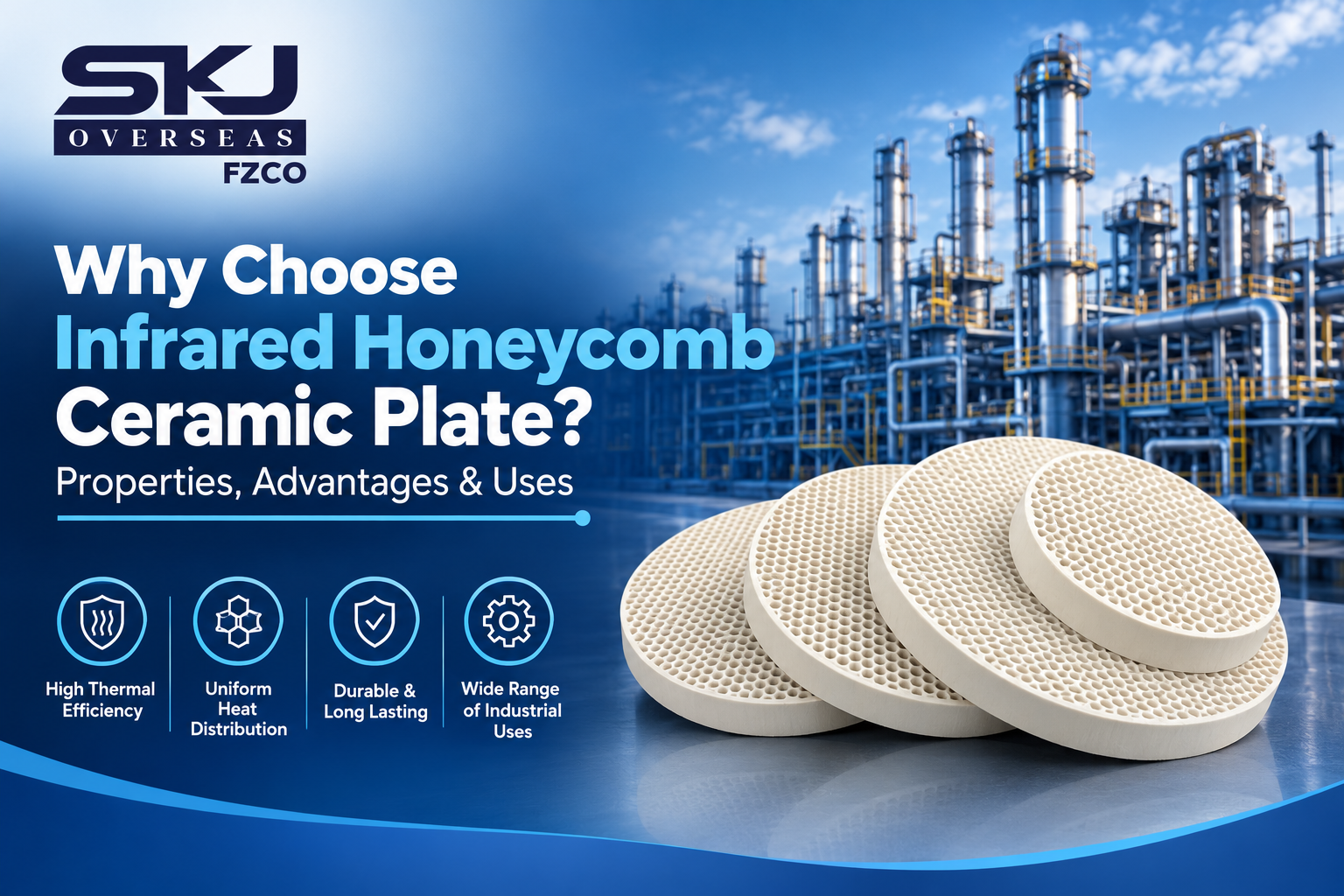
An infrared honeycomb ceramic plate is a fired ceramic component, typically made from cordierite, formed with hundreds of small, evenly spaced holes running through its thickness. Gas and air pass through these holes and combust at the plate’s surface, where the ceramic material heats to incandescence and radiates infrared energy directly outward.
This combustion method differs fundamentally from an open flame burner, since the heat is generated and radiated from the ceramic surface itself rather than from a visible flame alone. The result is faster surface heating, more even heat distribution, and significantly more complete fuel combustion than conventional burner designs achieve.
Typical technical specifications include:
- Hole diameter typically ranging from about 1.1mm to 1.8mm
- Plate thickness generally between 8mm and 15mm, depending on application
- Open porosity of roughly 60%, allowing efficient gas and air flow
- Softening temperature above 1280°C, with surface operating temperatures reaching 1000°C to 1200°C
- Density typically between 0.6 and 0.9 g/cm³
- Low thermal expansion coefficient, supporting strong thermal shock resistance
Why Engineers Choose Infrared Honeycomb Ceramic Plate Over Alternatives
More Complete Combustion Reduces Harmful Emissions
The honeycomb structure forces gas and air to mix thoroughly as they pass through the small holes, which promotes more complete combustion than a conventional open burner can achieve. More complete combustion means less unburned fuel escaping as carbon monoxide, which is why properly designed infrared ceramic burners can achieve very low CO and NOx emission levels compared to standard gas burners.
Faster Heat-Up and More Even Radiant Output
Because the ceramic surface itself becomes the radiant heat source once it reaches operating temperature, infrared honeycomb ceramic plates heat up faster and distribute heat more evenly across the burner surface than open flame designs. This even distribution reduces hot and cold spots, which matters significantly in cooking, grilling, and industrial heating applications where consistent surface temperature affects product quality.
Improved Fuel Efficiency
The combination of complete combustion and direct radiant heat transfer means more of the fuel’s energy converts into usable heat rather than escaping as waste. This efficiency gain is one of the primary reasons appliance manufacturers choose infrared honeycomb ceramic plate technology over conventional burner heads, particularly in applications where fuel cost or energy certification targets matter.
Strong Thermal Shock Resistance Extends Service Life
Cordierite’s low thermal expansion coefficient gives the plate strong resistance to cracking under the repeated rapid heating and cooling cycles typical of burner ignition and shutoff. This durability directly reduces replacement frequency compared to burner components made from materials more prone to thermal stress damage.
Stable High-Temperature Performance
With a softening temperature well above typical operating conditions, infrared honeycomb ceramic plates maintain their structural integrity and porous channel geometry even under continuous high-heat operation. This stability ensures combustion performance remains consistent over the component’s service life rather than degrading as the material ages.
Common Applications of Infrared Honeycomb Ceramic Plate
Infrared honeycomb ceramic plates appear across a wide range of gas-fired heating and cooking equipment:
- Gas infrared burners used in commercial and industrial heating systems
- Gas stoves, cooktops, and infrared-style gas ranges
- Outdoor BBQ grills requiring fast, even radiant heat
- Commercial and domestic ovens
- Patio and space heaters using infrared radiant technology
- Gas water heaters
- Industrial drying and curing equipment requiring controlled radiant heat
Infrared Honeycomb Ceramic Plate vs Conventional Metal Burner Heads
| Feature | Conventional Metal Burner | Infrared Honeycomb Ceramic Plate |
| Combustion completeness | Moderate | High |
| Emissions (CO, NOx) | Higher | Significantly lower |
| Heat-up speed | Slower | Faster |
| Heat distribution | Less even | Even, consistent surface temperature |
| Corrosion resistance | Prone to rust and scaling over time | Excellent, chemically stable |
| Thermal shock resistance | Moderate | Strong, with low thermal expansion |
| Typical lifespan | Shorter under repeated cycling | Longer with proper installation |
How to Choose the Right Infrared Honeycomb Ceramic Plate Specification
Selecting the correct plate specification depends on the appliance’s burner design, gas type, and required heat output.
- Hole diameter and spacing: smaller, more tightly packed holes increase surface area and combustion intensity, while larger holes suit higher flow rate applications
- Plate thickness: thicker plates generally offer greater mechanical durability, while thinner plates heat up faster
- Plate size and shape: must match the burner housing dimensions precisely to ensure proper gas distribution and sealing
- Custom hole patterns: some applications benefit from non-uniform hole layouts to control flame shape or heat concentration in specific zones
Working with an experienced manufacturer ensures the specification selected matches your appliance’s actual combustion requirements rather than relying on a generic, one-size-fits-all plate.
Installation and Handling Considerations
Infrared honeycomb ceramic plates, like most fired ceramic components, require careful handling during installation since they can crack under severe mechanical impact. Proper seating within the burner housing and correct gas pressure settings are also necessary to achieve the plate’s full efficiency and emissions performance.
These plates are also not well suited to applications requiring only very low, simmer-level heat output, since their design is optimized for the higher surface temperatures that drive efficient infrared radiation. Manufacturers and installers should follow the specific guidance provided for each plate specification to achieve consistent results.
Why Manufacturing Quality Determines Real-World Performance
Not every infrared honeycomb ceramic plate on the market is fired to the same density, porosity, and dimensional consistency standard, even when labeled with similar specifications. Inconsistent hole spacing or variable wall thickness can significantly affect combustion quality, emissions performance, and how evenly the plate heats across its surface.
When evaluating an Infrared honeycomb ceramic plate manufactures partner, confirm documented hole diameter tolerances, porosity testing, and thermal shock resistance data before committing to a specification. SKJ Overseas manufactures its infrared honeycomb ceramic plate range under controlled firing conditions, giving appliance manufacturers confidence that lab-tested combustion performance will hold up once installed in a working burner.
Sourcing Infrared Honeycomb Ceramic Plate From a Verified Source in Dubai
Working with an established Infrared honeycomb ceramic plate in dubai source gives regional appliance manufacturers shorter lead times and more direct technical support during product development or a production run. This proximity matters significantly when a manufacturing line depends on a steady, predictable supply of consistently sized plates.
A dependable Infrared honeycomb ceramic plate exporters partner also simplifies logistics for companies managing multiple component sourcing requirements across a single product line, reducing the number of vendors involved in appliance production.
Key Takeaways
- Engineers choose Infrared Honeycomb Ceramic Plate for its more complete combustion, lower emissions, and faster, more even radiant heat output.
- Cordierite construction gives the plate strong thermal shock resistance and stable performance at high operating temperatures.
- Common applications include gas burners, stoves, grills, ovens, heaters, and water heaters.
- Hole diameter, spacing, and plate thickness should be matched to the specific burner design and heat output requirement.
- Sourcing from a manufacturer with documented porosity and thermal testing protects combustion performance after installation.
Frequently Asked Questions
1. What makes infrared honeycomb ceramic plate better than a standard metal burner?
The honeycomb structure promotes more thorough gas and air mixing, resulting in more complete combustion, lower emissions, and faster, more even radiant heat compared to conventional open-flame metal burners.
2. What temperature can infrared honeycomb ceramic plate withstand?
Most infrared honeycomb ceramic plates have a softening temperature above 1280°C, with typical surface operating temperatures reaching 1000°C to 1200°C during normal combustion.
3. Is infrared honeycomb ceramic plate suitable for low simmer-level heat?
Not ideally. The plate’s design is optimized for higher surface temperatures that drive efficient infrared radiation, so it performs best at standard to high heat settings rather than very low simmer levels.
4. How durable is infrared honeycomb ceramic plate under repeated heating and cooling?
Cordierite’s low thermal expansion gives the plate strong resistance to thermal shock, allowing it to withstand repeated ignition and shutoff cycles without cracking when properly installed and handled.
5. Can infrared honeycomb ceramic plate be customized for a specific burner design?
Yes. Manufacturers can typically adjust hole diameter, spacing, plate thickness, and overall shape to match a specific burner housing and combustion requirement.
Talk to SKJ Overseas About Infrared Honeycomb Ceramic Plate
Choosing the right infrared honeycomb ceramic plate specification directly affects your appliance’s combustion efficiency, emissions, and product lifespan. SKJ Overseas manufactures infrared honeycomb ceramic plates engineered for consistent porosity, thermal stability, and combustion performance.
Contact us to request a quote, a technical datasheet, or a sample for your burner application.