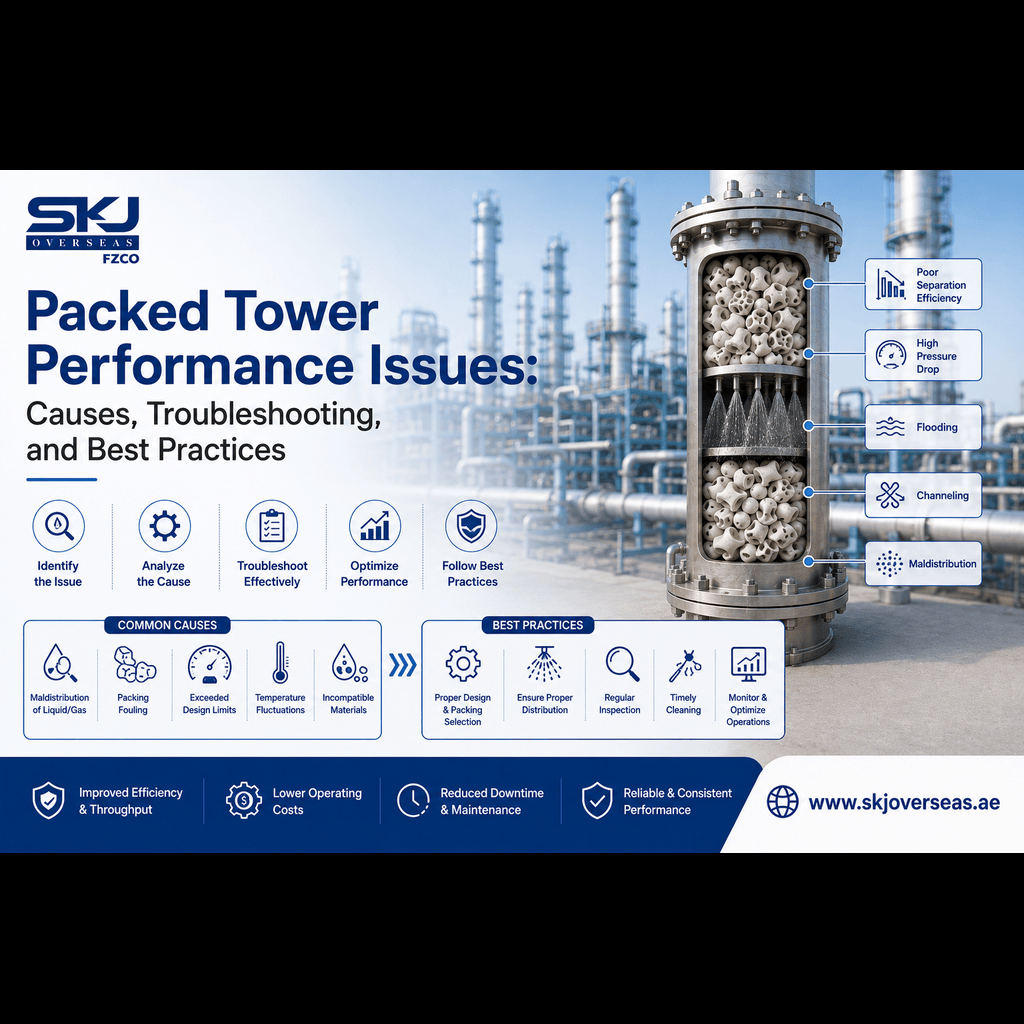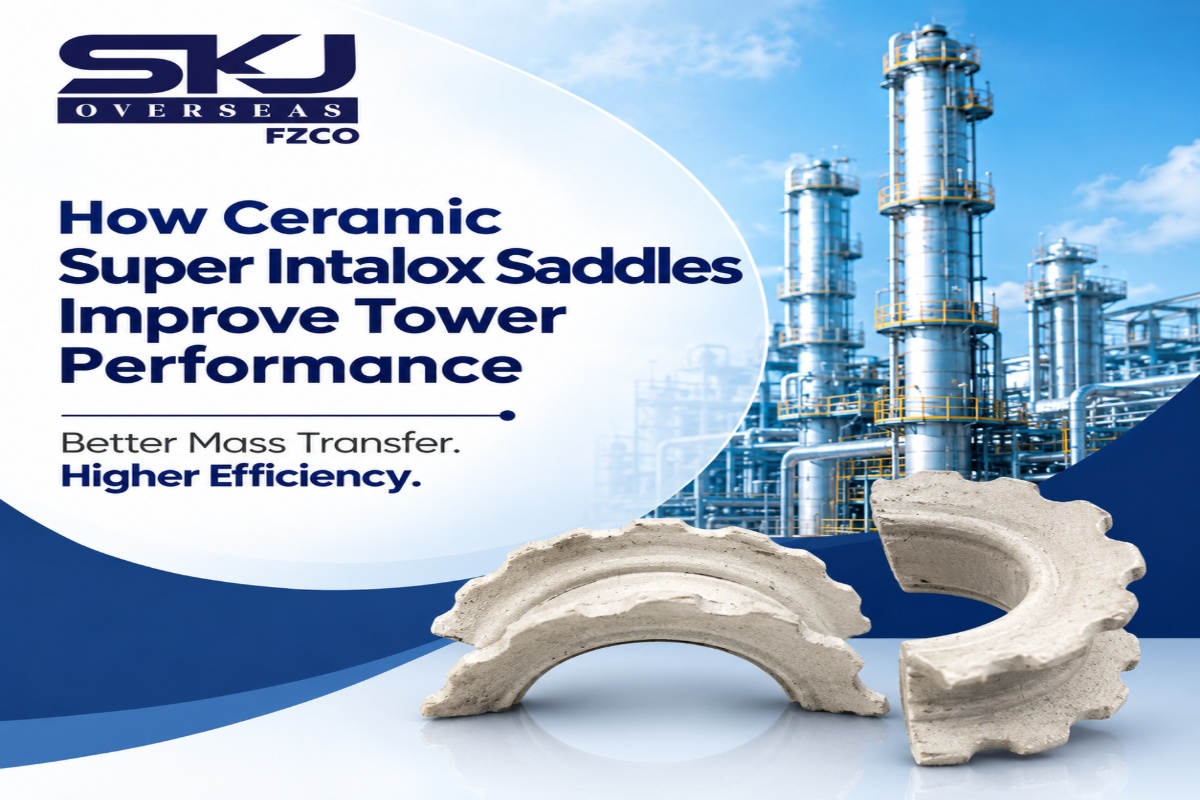
If your packed column struggles with flooding, uneven liquid distribution, or high pressure drop, the packing media is often the root cause. Ceramic Super Intalox Saddles improve tower performance by combining a curved, no-nest geometry with high surface area and excellent chemical resistance. This makes them a preferred choice for absorption, distillation, and scrubbing towers across the chemical, fertilizer, and petrochemical industries.
At SKJ Overseas, a trusted Ceramic Manufacturer in Dubai and a leading Ceramic and Tower Packing Exporter in Dubai, we manufacture and supply saddle packing engineered for demanding, corrosive service conditions. In this guide, we break down how this packing type works, why it outperforms older designs, and how to choose the right size for your process.
What Are Ceramic Super Intalox Saddles?
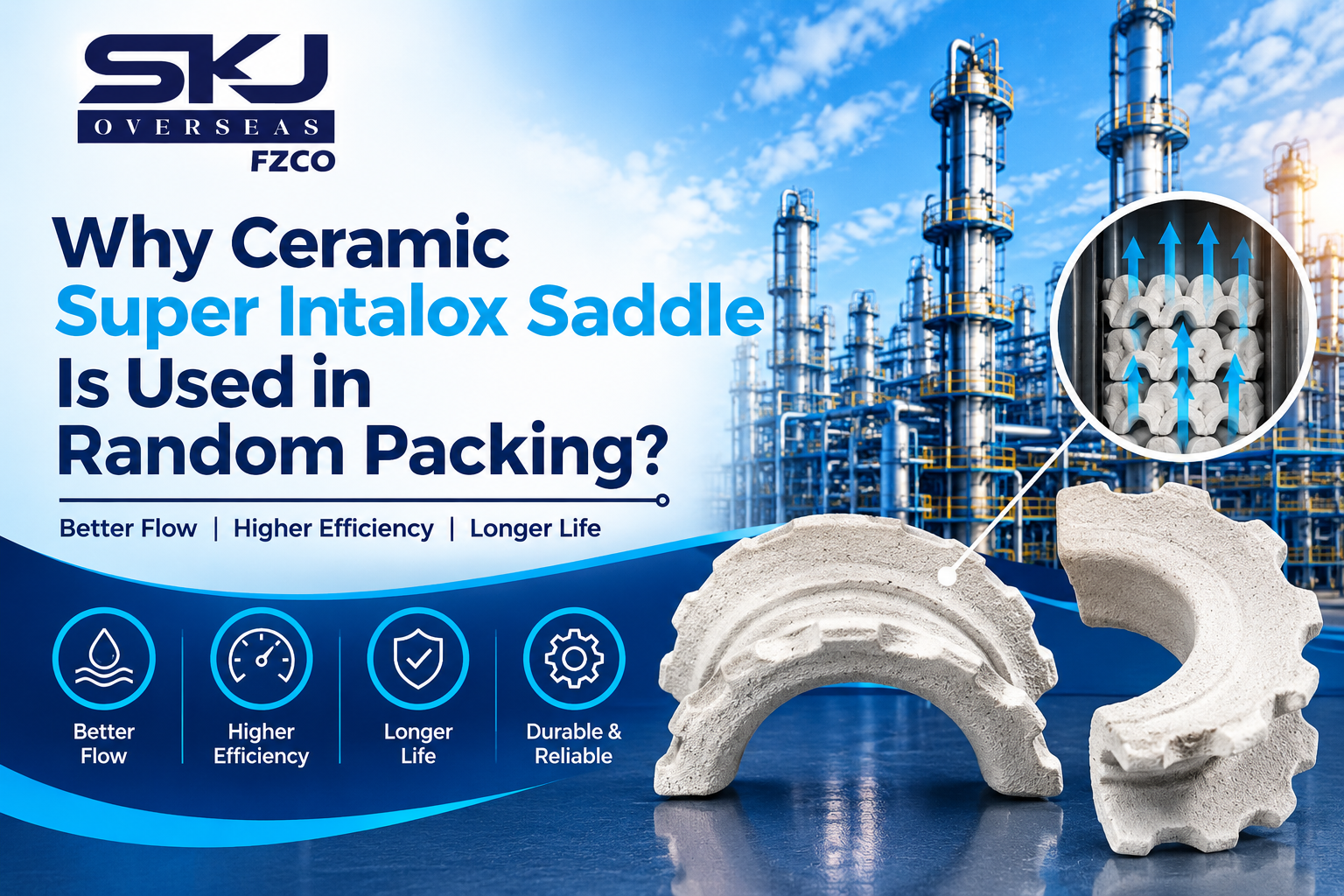
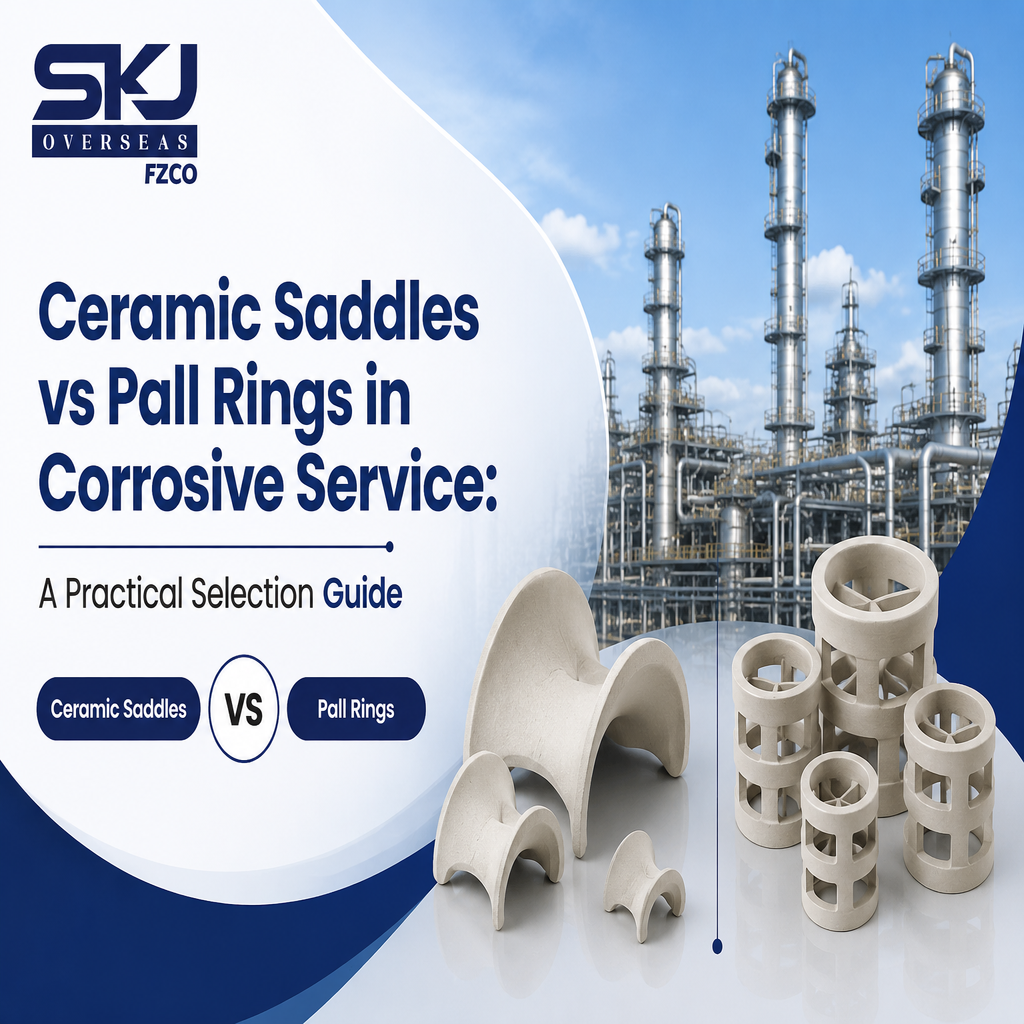
Ceramic Super Intalox Saddles are a type of random tower packing shaped like a curved, ridged saddle rather than a simple ring. The saddle shape was developed to improve on the original Intalox saddle and the older Raschig ring, both of which suffer from nesting and uneven flow paths.
The ridged, scalloped walls of the saddle prevent individual pieces from stacking flat against one another inside the column. This “no-nest” design keeps gas and liquid channels open throughout the packed bed, which is the main reason these saddles are widely used by any Ceramic Super Intalox Saddle Manufacturer serving the oil, gas, and chemical processing sectors.
Key structural features include:
- Curved, torus-shaped body for open flow channels
- Corrugated or wavy inner surface for better film distribution
- Thin-wall ceramic construction to maximize free volume
- Uniform sizing for predictable packing density
Why Tower Performance Depends on Packing Design
A packed tower’s job is to bring gas and liquid into close contact so mass transfer (absorption, stripping, or distillation) can happen efficiently. Poor packing geometry limits that contact, no matter how well the rest of the tower is designed.
Three factors decide how well a tower performs:
- Surface area – more contact area between gas and liquid improves mass transfer
- Free volume (void space) – higher void space allows more throughput before flooding
- Pressure drop – lower resistance means the tower runs efficiently with less energy
Ceramic Super Intalox Saddles are engineered to balance all three. Independent packing data shows surface areas ranging from roughly 105 m²/m³ for 3-inch saddles up to 260 m²/m³ for 1-inch saddles, with void fractions between 77% and 79% depending on size. This combination is difficult to match with older packing shapes of similar cost.
How Ceramic Super Intalox Saddles Improve Tower Performance
1. Higher Surface Area for Better Mass Transfer
Because the saddle shape avoids flat stacking, more of each piece’s surface stays exposed to both gas and liquid. Compared to Raschig rings of the same nominal size, saddle-type packing offers noticeably higher specific surface area and slightly greater free volume. More exposed surface area means more opportunity for the liquid film to absorb or release the target compound, which directly increases separation efficiency per meter of packed bed height.
2. Lower Pressure Drop Across the Column
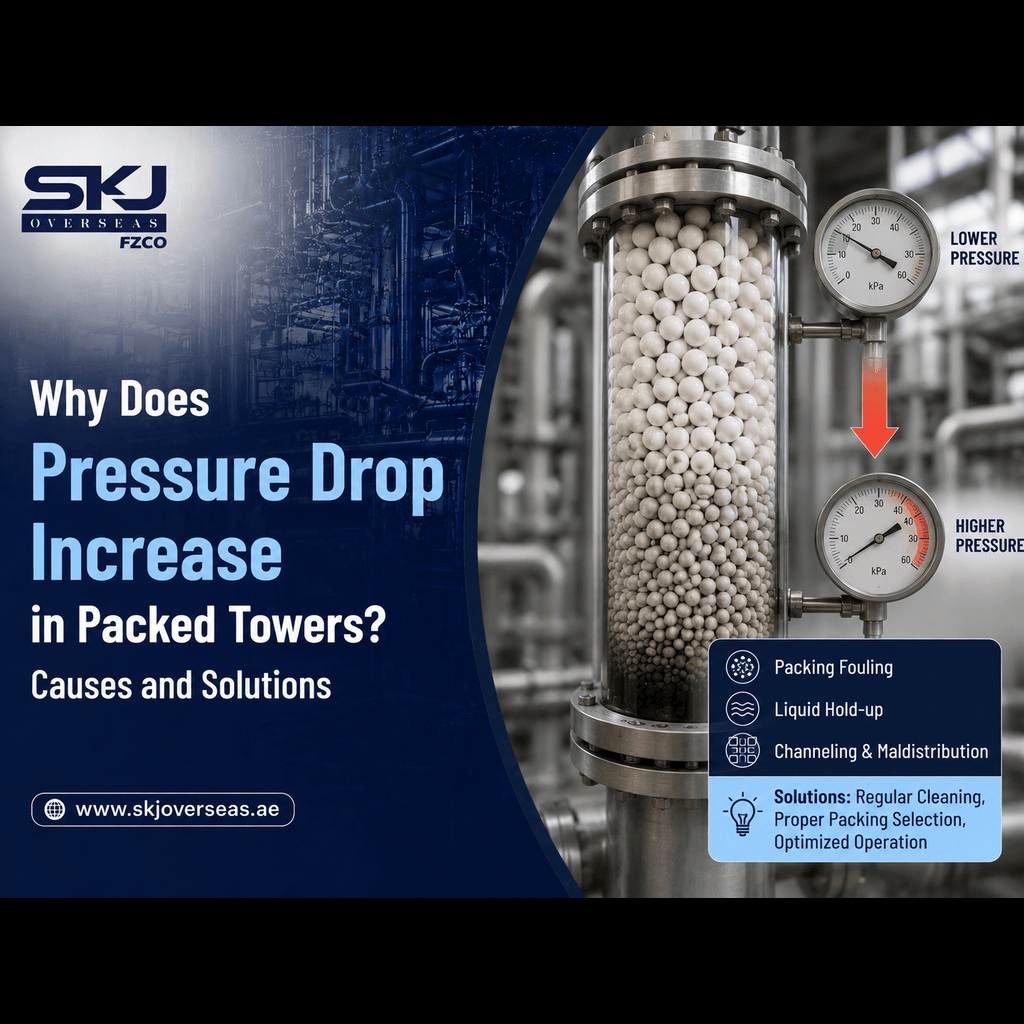
The open, curved geometry reduces the resistance gas has to overcome as it rises through the packed bed. Lower pressure drop translates into lower energy costs for blowers and compressors, and it delays the onset of flooding at higher gas velocities. For towers running near their capacity limit, this can be the difference between stable operation and a costly shutdown.
3. Even Liquid Distribution and No Channeling
Uneven liquid distribution, sometimes called channeling, is one of the most common causes of poor absorption efficiency. The no-nest design of Super Intalox Saddles keeps liquid spreading evenly across the bed cross-section instead of pooling in a few narrow paths. Even distribution means the entire packed height contributes to separation, not just a fraction of it.
4. Outstanding Chemical and Thermal Resistance
Ceramic packing is chemically inert to almost all acids, alkalis, salts, and organic solvents, with hydrofluoric acid being the notable exception. It also withstands high operating temperatures, with many grades rated for continuous service up to around 1100°C. This makes ceramic saddles ideal for aggressive environments such as sulfuric acid drying towers, chlorine scrubbers, and acid regeneration units, where metal or plastic packing would corrode or degrade.
5. Structural Stability Under Load
A packed bed can be several meters tall, and the packing at the bottom carries the full weight of everything above it. The saddle shape distributes mechanical load more evenly than rings, reducing the risk of crushing or fracturing under normal operating pressure. This extends packing life and reduces the frequency of costly bed replacement.
Ceramic Super Intalox Saddles vs Other Packing Types
| Feature | Raschig Rings | Intalox Saddles | Super Intalox Saddles |
| Nesting risk | High | Moderate | Very low |
| Surface area | Lower | Moderate | High |
| Pressure drop | Higher | Moderate | Low |
| Liquid distribution | Uneven | Good | Excellent |
| Best use case | Light-duty service | General absorption | High-capacity, corrosive service |
Common Industrial Applications
Ceramic Super Intalox Saddles are used wherever a tower needs high efficiency combined with chemical durability:
- Sulfuric acid drying and absorption towers
- Gas scrubbing and flue gas desulfurization units
- Chlorine and HCl absorption columns
- Distillation columns in petrochemical plants
- Cooling towers and wastewater treatment systems
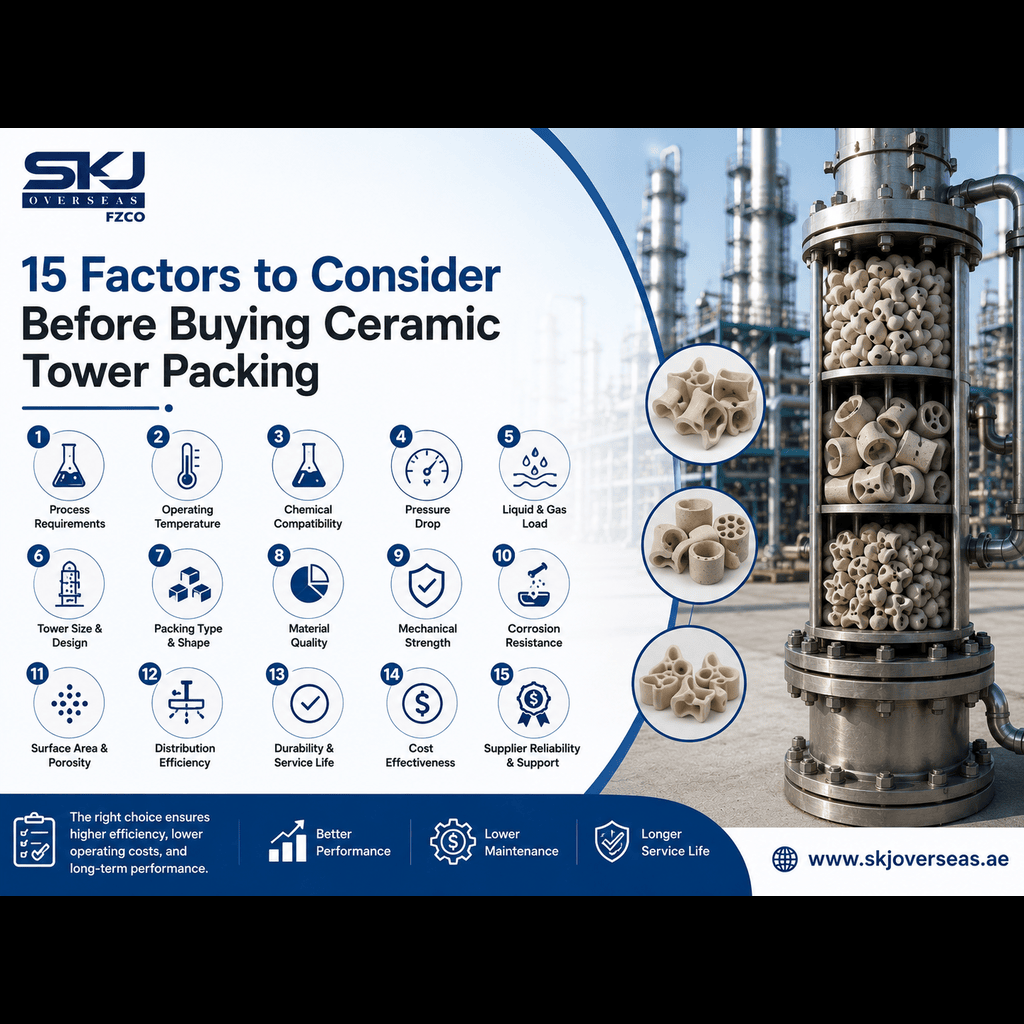
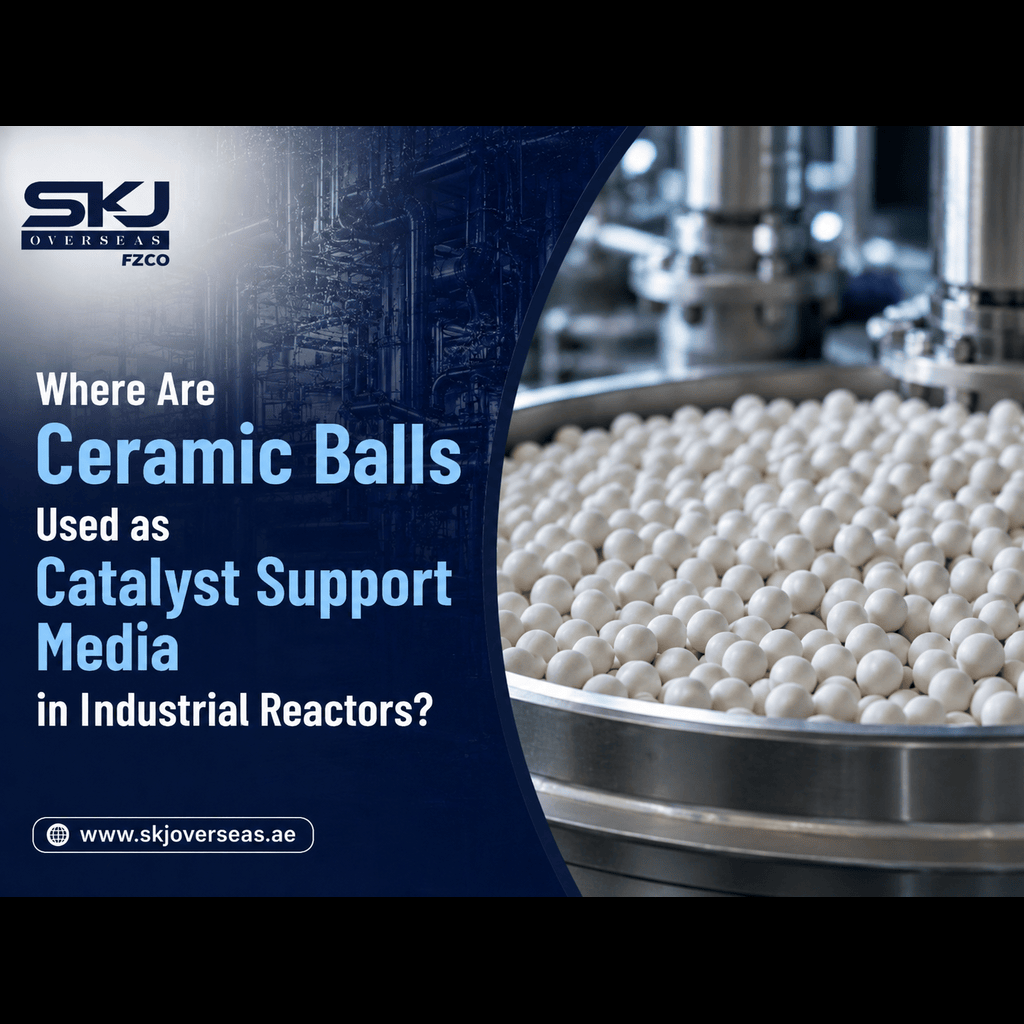
- Catalyst support beds in reactors
How to Choose the Right Saddle Size
Selecting the correct saddle size depends on tower diameter, expected gas and liquid loading, and the required separation efficiency. As a general rule:
- Smaller saddles (1/2 inch to 1 inch): higher surface area, better for smaller-diameter towers and lower flow rates
- Medium saddles (1.5 inch to 2 inch): balanced performance, common in general-purpose absorption towers
- Larger saddles (3 inch and above): lower pressure drop, suited to high-capacity towers with large gas volumes
A packing supplier with hands-on process experience can help match saddle size to your specific tower geometry and chemical duty, which is where working with an established Ceramic Super Intalox Saddle Supplier in Dubai makes a measurable difference to long-term tower efficiency.
Why Source From a Verified Ceramic Super Intalox Saddle Exporter
Not all ceramic packing is manufactured to the same quality standard. Wall thickness, firing temperature, and raw material purity all affect how long the packing lasts and how consistently it performs under load. Working with a proven Ceramic Super Intalox Saddle in Dubai supplier ensures:
- Consistent dimensional accuracy for predictable packing density
- Verified acid and alkali resistance testing before dispatch
- Proper firing to avoid micro-cracking under thermal cycling
- Reliable export documentation and packaging for safe transit
SKJ Overseas manufactures and exports ceramic saddle packing that meets these standards, giving process engineers confidence that tower performance data will hold up under real operating conditions.
Key Takeaways
- Ceramic Super Intalox Saddles improve tower performance through higher surface area, lower pressure drop, and even liquid distribution.
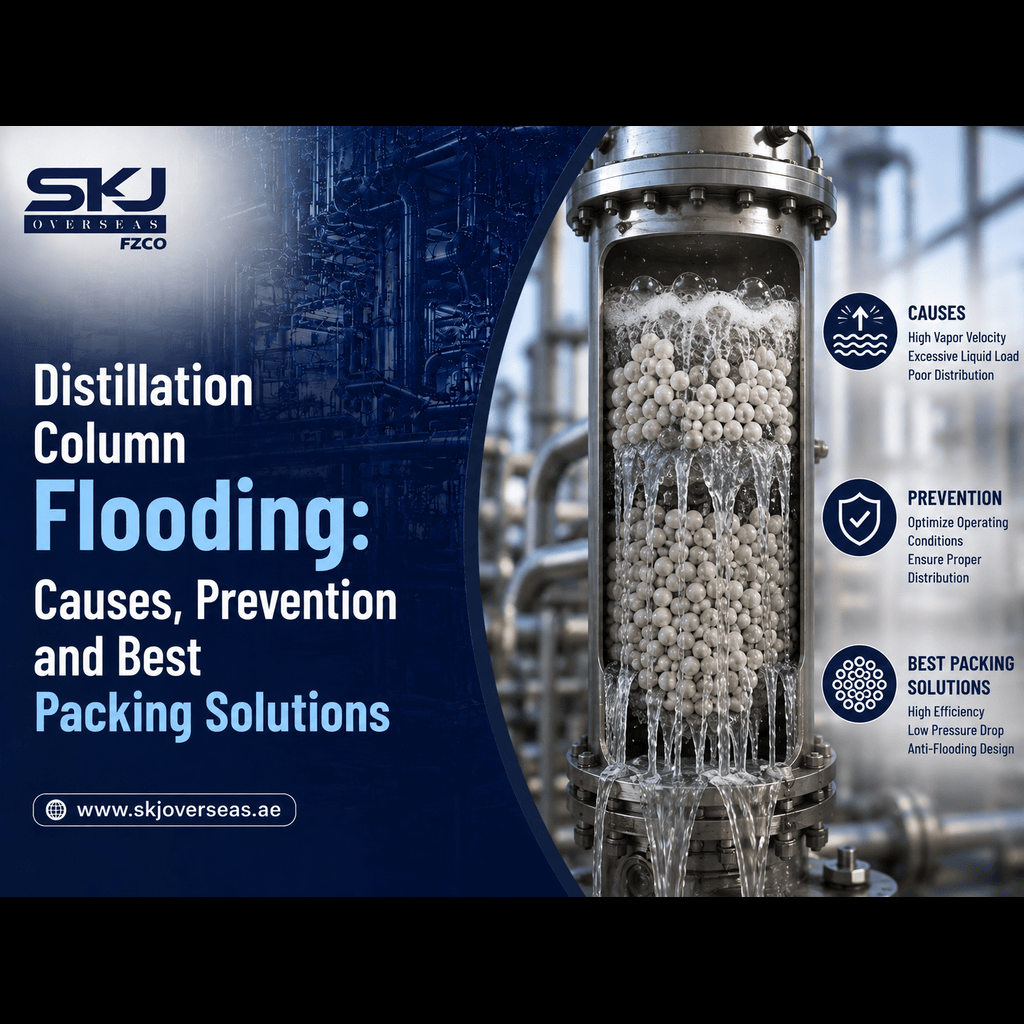
- The no-nest saddle geometry solves the channeling and flooding problems common with older packing designs.
- Ceramic construction offers excellent resistance to acids, alkalis, and high temperatures, except hydrofluoric acid.
- Correct saddle sizing depends on tower diameter, flow rate, and required separation efficiency.
- Sourcing from a reliable manufacturer directly affects long-term packing performance and tower uptime.
Frequently Asked Questions
1. What makes Super Intalox Saddles different from regular Intalox Saddles?
Super Intalox Saddles have a more refined, wavy or ridged surface profile than standard Intalox saddles. This added texture increases surface area and further reduces nesting, giving better gas-liquid contact and lower pressure drop for the same nominal size.
2. Can ceramic saddles handle high-temperature processes?
Yes. Ceramic Super Intalox Saddles typically withstand continuous operating temperatures up to around 1100°C, making them suitable for hot gas absorption and drying tower applications where plastic packing would fail.
3. Are ceramic saddles resistant to all chemicals?
Ceramic saddles resist almost all acids, alkalis, salts, and organic solvents. The main exception is hydrofluoric acid, which attacks ceramic materials and requires an alternative packing material.
4. How do I know what size saddle my tower needs?
Saddle size selection depends on tower diameter, gas and liquid flow rates, and the separation efficiency required. Smaller saddles offer more surface area for smaller towers, while larger saddles suit high-capacity columns needing lower pressure drop.
5. How often does ceramic tower packing need replacement?
With proper sizing and installation, ceramic saddle packing can last many years of continuous service. Replacement is usually driven by mechanical breakage, fouling, or a process change rather than routine wear, since the ceramic material itself does not corrode under normal operating chemicals.
Get Ceramic Super Intalox Saddles From SKJ Overseas
Looking for a dependable Ceramic Super Intalox Saddle Manufacturer and Ceramic Super Intalox Saddle Exporter for your next tower packing project? SKJ Overseas supplies ceramic saddles engineered for high-efficiency mass transfer and long service life in corrosive, high-temperature environments.
Contact SKJ Overseas today to request a quote, technical datasheet, or sample for your tower packing requirement.